Sunday, July 29, 2018

Summertime, Vikings and Alpacas

Oops this got a bit derelict didn't it? From once a week to nothing for three months. Wow. Well I am back and have changed up the format a bit (similar to my other blog A2Steam) and will be doing smaller write ups on specific games and bunching them together every few weeks.

Also noticed some new followers on the Facebook site, welcome, hope you like what you read. 


RAIDERS OF THE NORTH SEA


The first of a trio of similarly themed games where players partake in the Viking Age. I've given this one a number of plays now and it is very good. At its core Raiders is a worker placement game, each turn you place a worker and perform an action and then you pick up a worker, performing that action. These must be different actions and the workers don't belong to any single player, so you could be picking up workers another player has put down in a previous turn. There are also three tiers of worker - some being better/worse at certain actions, some action being exclusive to a particular tier.

Actions such as getting supplies, gold and hiring crew are all in service of going out and raiding. Once you think you are reads you take a "double" action (uses up both of your actions for the turn) to raid an outpost. This will use up a worker permanently but in return gives you resources and usually access to a higher tier worker. These resources can be turned in for point (raiding also get you points), armor and gold (to hire more crew). Sometime raiding will lead to the death of some of your crew, that also get you points. The game ends when a certain amount of top tier outposts have been raided.

A lot of Raiders is about pushing to get the good stuff first without over reaching and loosing too much. The outposts are first come first serve so you can't dawdle, but the pace will be set by other players so if the other players are taking their time that gives you some breathing room. Raiders scales well (2-4 players) and moves quickly.

I've really enjoyed this one. From simplicity of rules to interesting decisions, without being a brain burn. Raiders also looks good too with the components being top notch and lovely art. 


SHIPWRIGHTS OF THE NORTH SEA


This is the second of the three games in what I am going to call the North Sea Trilogy and Shipwrights is for sure a different game from Raiders. Unlike the worker placement and resource management of Raiders, this one is mostly card based. 


Each round players draft cards, then play them as craftsmen or use them as one off actions, then they get their gold and workers for the next day with the goal to have the most points when someone has built their fourth ship (ending the game). Easier to build ships are worth less points but you could attempt to race out the game vs those who are building bigger ships. There is also a lot of "take that" game play in the action cards - though none of it feels harsh, more like player created obstacles for you to overcome.


Just like Raiders, the components are top quality and it all looks very nice. Turns go by quickly and it the pressure to get what you need and build it first feels good. It is a much lighter game than Raiders but it fills it's own niche in this trilogy.

I have to make a note that we did play the game wrong - which lead to it taking longer than it should have to play because we we hoarding craftsmen cards. I am looking forwards to playing it correctly...oops.


EXPLORERS OF THE NORTH SEA


The final game in this trilogy really reminds me of Akrotiri but expanded out for more players. In Explorers you are sending out your boat and vikings to explore new lands, gather animals, build outposts and raid settlements.

The basic loop of game play involves a player placing a hex (with ocean and islands on it) on the board, connecting it to previous placed hexes. Then they take actions such as moving their ship, loading and unloading animals and vikings, building outposts, raiding settlements, bringing animals back to the mainland for points and having battles with ships. Most of the actions you take earn you points and doing them in certain ways earns cumulatively more. There is a race between the players to get what they need from the islands and each player also has unique conditions that will earn them extra points when the game is over, which happens when the last hex is placed, so everyone can see the timer ticking down.

It seems the most random of the three games as you don't have any control over where other players put their hexes and you often can't place the ones you have exactly where you want them as they have to match sea to sea and land to land. Combined with the random content of the hexes you do the best you can and try no to make it easy for your opponents and no to hard for yourself.

Explorers of the North Sea moves quickly and the race to get what you want adds pressure but the randomness keeps it somewhat casual. I quite enjoyed it and am looking forwards to additional plays.

ALITPLANO


I am a big fan of Orléans and when another game by Reiner Stockhausen was announced I got very excited. It turned out to be immediately very popular and it took a bit to get a copy but I am glad I did.

In Altiplano you are working a mechanic similar to Orléans, acquiring tokens, putting them in a bag to draw at random and use for various actions. The big difference in Altiplano is not just how they get used but the much more temporary relationship you have with them. In  Orléans they form an every recycling source of "action fuel", in Altiplano they come and go much easier and that's the hook. You are moving around a series of plateaus, each with their own actions on them. You first act is to make sure you can get to where you want to spend the token you have placed onto your planning board. Some of the actions just require to you place the spend tokens into your discard basket, which you cycle back once your draw bag is empty. The rest of the time you are permanently spending these tokens either turning them into better tokens or placing them into your warehouse, which is the meat of the scoring.

Each player has a warehouse to store the various goods in. But how and where you can place and stack goods has a particular set of restrictions that keep you hopping. You want to fill whole rows for points but you can't start a second row of a goods type till you have finished partially full ones. You consistently juggle how long to hold onto goods to use for actions or when to store them away forever. And all the good are in limited quantities, so first come first serve puts pressure on those players competing in similar goods.


Initially Altiplano can seem daunting with a lot of actions on your planning board, more actions on the plateaus and even more actions can be purchased as attachments but as you are restricted to work with what you draw it becomes more clear. Place and plan the best you can for the current turn and que up actions for later turns. 

I initially was worried that Orléans and Altiplano would be too similar, but they are much different beasts once you see how they play out. I really like Altiplano, though it is unlikely replace Orléans as one of my more favorite games in recent years, it stands tall on its own and is a great example of how a similar mechanic can be used to create a completely different feel.

JAIPUR


Jaipur is a lovely little award winning two player that was introduced to me a number of years ago and once I was able to get a copy has seen a good amount of play.

In Jaipur each player is attempting to score points via card set collection. There is a market of five colored goods cards in the middle of the table and on you turn you can either take 1 goods card and refresh from the deck, take as many goods cards as want, trading equal amount from your hand or take all the camels in the market, placing them in from of you. Instead of trading goods cards you can spend any number of camels and take that many goods cards, replacing them with camels. Finally instead of working the market you can instead discard a number of same colored goods from your hand to claim one of the same colored score markers. These markers are limited, with the ones worth more points harder to get and fewer in number. You claim the markers with just a few cards but the more you spend the higher the bonus you get. The game ends once a certain amount of score marker piles are empty so the race is on.

Jaipur does it's job very well. The pacing between players of what cards to take, what to trade, camel use and when to cash in for points is great. A combination of pushing your luck and outguessing your opponent. It plays quick and is designed for a best two-out-of-three setup so even if the first game goes bad for you there is time to recover. I well recommend it if you are looking for fast paced two player game with great back and forth. Also now that it seems to be regularly back in print it's not a pain to get.


*****

Well that's it for this month, I will be back at the end of August with five more games. Thanks for reading and I hope you found something you like.


Sunday, April 15, 2018

The Networks


THE NETWORKS

When I am not playing board games or video games I watch a decent amount of TV. Not random but specific shows that I like season after season. I am the kind of viewer that the TV executives in The Networks would want. Although to be fair they want any and all the viewers.

In The Networks each players is in charge of a TV network and over the course of the 5 season game they will decide the programming for the all important evening line up. It's all about getting the right shows, the best actors and that sweet ad revenue to get you the most viewers (victory points).

Each round of The Networks is a season. In turn order players will pick from a variety of available TV shows, actors, ads and special action cards. Each turn you get a single action, with play being continuous until everyone drops out. You have to balance your money (actors and shows cost you money) with your income (from ads and a bonus, higher the earlier you drop out in around). Each TV show has a preferred time slot that will bring it the best viewers and as the seasons go by the number of views fluctuate. You can bolster a show by adding a star or two (if it allows), but they cost you more money. Maybe attach an ad to offset these costs? Or pick a special action card to give you a specific bonus when you most need it. It might just be time to put a show into reruns and make room for something new. 

There is a lot I like about The Networks. The core loop of mechanics, balancing your money to get the most viewers out of your expenditures versus the timing of when to pick a card before someone else gets it feels really great. There is a lot of open information in the game but because you only get a single action every time you do something you are putting of another opportunity that may not be around when it comes back to your turn. It is a good combination of resource management and pushing your luck. I do have an issue with going last on the first round in 4/5 player games as even though you get more money the number of opportunities is small enough you can end up a good 10 or more points behind that you have to hope you can make up in later rounds.

I also enjoy the art and style of the game. Each of the shows have a humorous name that is a pun or parody on an actual existing show from the last decade or so (some older more well know shows too). The actors all have generic descriptions but between that and the art you have a good idea of who they are parodying. Along with the card art it adds a nice bit of mirth to the game.

The Networks was a game that I bought almost entirely on hearing about its concept but like a new TV show I am happy to have tuned in.

Saturday, April 7, 2018

Golf


GOLF

Okay this week I've got something for anyone who has a deck or two of standard playing cards sitting around - Golf!

You will need a deck of cards for every 2 players, the full 52 + 2 jokers. Shuffle them and hand out 8 to each player. They don't get to look at them but place them face down in two rows of 4. Then each player flips 2 cards over and the game begins.

On your turn you either take the top card from the deck or the discard pile. If you draw from the deck you can either choose to keep it, swapping out one of your cards (face down or up) or discard it and then flipping over any 1 of your face down cards. If you draw from the discard you must swap out a card. Once you only have a single face down card left (the rest are face up) you no longer have to flip when drawing from the top of the deck, you can choose just to discard the drawn card. As soon as someone has flipped all their cards each other player gets 1 more turn and the round is over.

Your score is the total value of all your cards with some differences. Kings are zero, Jokers are -2 points. Aces are 1 but Jacks and Queens are 10. If you have a matching pair in a column they cancel out and score zero (except for Jokers). If you have 4 matching cards in 2 adjacent columns each other player scores 20 points. Just like real golf you want a low score so making pairs, getting Kings and swapping out those high cards is a must. After 9 rounds who ever has the lowest score wins.

Golf has a lot of variants, from the number of cards you start with, to how they score - it's a game that everyone has their own preferred home rules (even the above rules description is just how I personally learned to play). Mix and match to your liking. 

I really like Golf. It has lots of good decision making in it, despite the luck of the draw factor. Do I keep this card? Should I push my luck for pairs? Discarding this card is really good for the next player, what should I do? Should I flip my cards fast to put pressure on the other players? It won't burn your brain and sometimes you are the the mercy of chance but I think it is a great card game to wind down an evening with.

Saturday, March 31, 2018

Fabled Fruit


FABLED FRUIT

So last week I reviewed Charterstone, a beefy legacy game full of all the typical things you would expect from a story telling campaign worker placement game, this week I am going to talk about a different kind of legacy game, Fabled Fruit.

A box of cards, that is what Fabled Fruit is at first glace. There are 2 decks of cards and some really nice wooden animal meeples. Your first game of Fable Fruit has you setting up a small selection of action cards (4 of each) in piles and dealing some fruit cards from a separate deck. Each turn  a player takes their animal and places it on an action card and either does the action or buys the card with fruit from their hand. Bought action cards are flipped and placed face down as fruit juice for that player, get enough and you win. 

The real interesting part comes is when after a card is bough a new card from the action pile comes out. There will be four of this cards so the first four purchases will bring out a whole new action pile. Once a player has enough fruit juices to win the game shows it's big trick. You don't put everything back the way it was, any cards that became fruit juice are removed from all future games in this play through. The actions cards in the center of the table at the end of a game is the set up for the next game. So in a legacy "light" move each game picks up from where the last left off. 

A game of Fabled Fruit only takes about 20 to 30 minutes to play and moves along a good pace. With the ever cycling set of action cards there is always something new to be doing. The action cards are numbered so that they come out in a specific order but as this our first play through each new card is a surprise and each time a pile of action cards that we have been relying on goes away we lament.

So much of the strategy to winning a game of Fabled Fruit is timing. Getting the right fruits, getting additional fruit, taking fruits from players, not having to pay out extra fruits (for going on an action that another player is on) and being able to get the fruit juice you've been saving for before someone else does is all part of it. 


I have only played about 8 games in our current play through and have gotten between a third and half way through the action card deck and am very impressed with the balance of how as cards and particular actions leave play the new ones change up the game play. We have had a few early cards stick around for some time as if some silent agreement between the players on their overall usefulness stopped us from buying them.

Unlike other legacy games Fabled Fruits has two big differences, first off it supports drop in and out play from game to game and even the number of players can vary second once you have finished the "campaign" of games you can just reset the game for another run through as no components are permanently removed or destroyed. 

While there might not be many components in a box of Fabled Fruit what is there is quality. The cards and animal meeples are very well done. The cards have unique animal art on all 60+ sets. The colors are bright and pop. The rules are light enough that it would easily work as a family game but interaction keeps a more experienced gamer like myself more than just entertained.

Fabled Fruit is actually a bit of a strange duck. It's light enough and flexible enough that the buy in effort is low, but the engagement and discovery level are much higher. You won't burn your brain but interactive tension is there. I like it a lot and am looking forwards to seeing what new actions are revealed and how they spice up the game in future plays.

Sunday, March 25, 2018

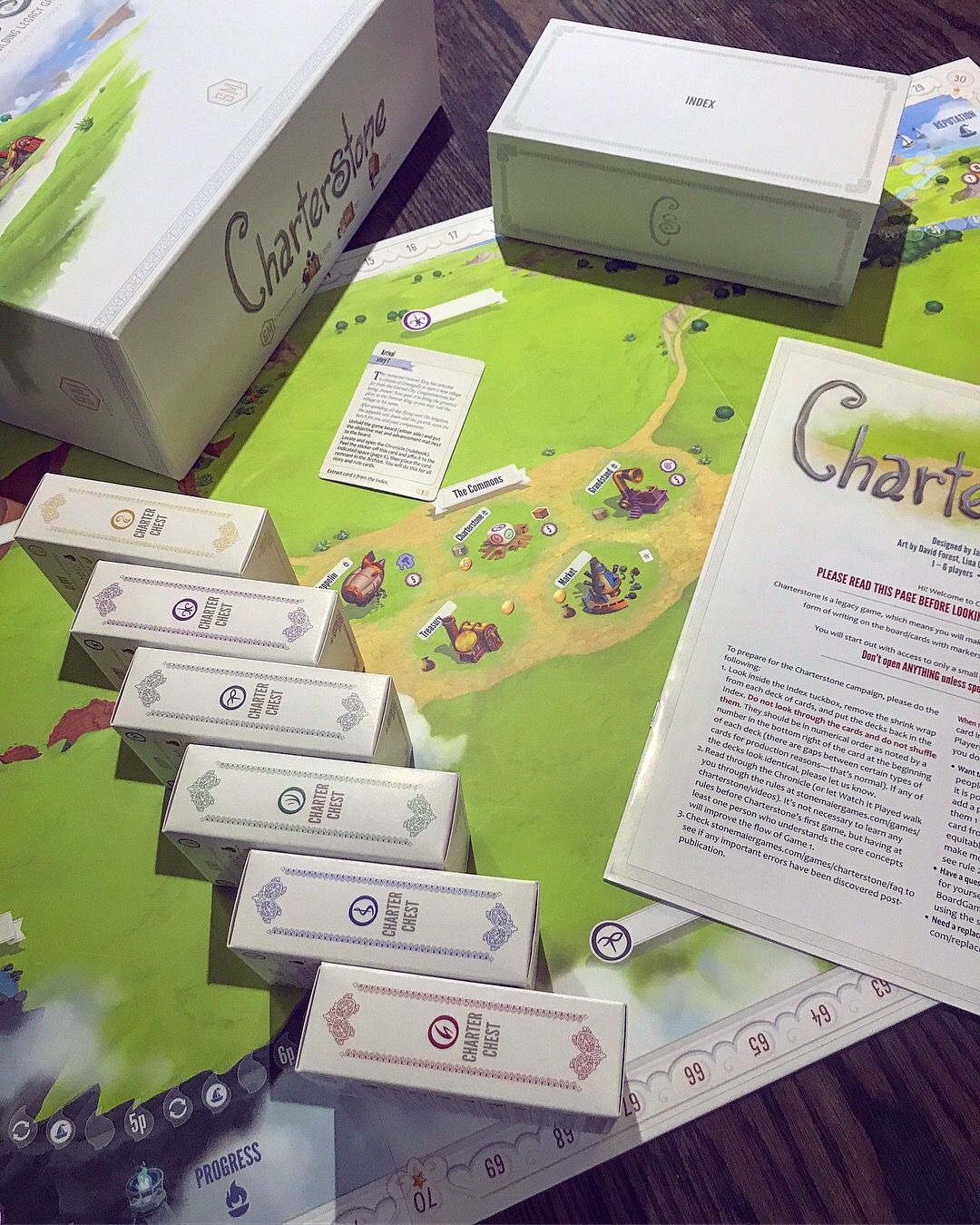
Charterstone


CHARTERSTONE

I am a fan of Mr.Stegmaier's games, I really like Euphoria and Viticulture is one of my favorite board games period. So when he announced Charterstone, I was quite excited. It was to be a legacy game and I had only played a few games into Risk: Legacy, which while it didn't exactly do it for me I found the concept very cool. So I pre-ordered and waited. Then we spent the first three months of 2018 playing through the 12 game campaign that makes up Charterstone.

*Just a heads up - it is pretty much impossible to talk much about or give any opinion on Charterstone without spoiling due to the nature of the game. I will attempt to keep spoilers to a minimum (thus not too many photos) but be warned - SPOILERS BELOW*

Charterstone is a legacy worker placement game where up to 6 people (we played with 3) build a town over the course of 12 games. All the standard worker placement tropes are present - place a worker, get resources, draw cards, play cards, etc. Spending your resources to play some of the cards is where the legacy part comes in, if you are constructing a building it is a sticker that you peel off the card and put on one of the designated area of the board. As the game goes on these additional buildings allow for more varied actions your workers can take. The left over card is kept by the player and can later be played again (for a different cost) to bring new cards out of a secret box into the game. Doing this and other things get you points, at the end of the game depending on how many points you have earned you get cumulative bonuses towards the next game. Each game will also have special rules and conditions that are set by decisions made in the previous game. At the end of 12 games who ever has done the best overall wins the campaign.

One of the first things I liked about Charterstone is the art and component aesthetic. It is all very nice looking and consistent. From the nearly empty board that is just full of future possibilities at the start to the crowded end game where it looks like a genuine bustling town. The core game mechanics that achieve this are mostly good, how both early games have simple worker mechanics guiding your process to the later games where each decision has more weight. Though I did have an issue with how in the first few games so many new rules and choices are unlocked mid-game that it was at times confusing and easy to forget them while you are still getting used to the core game play.

The game to game progression is a nice mechanic, earning points get you advancements towards additional income at the start of each game and allowing you to carry over more resources, money and cards from one play session to the next. Making this progress directly related to your victory points lead me to be bothered by one of the choices that kept coming up in our games, you either spent a session constructing building and opening new cards OR working towards earning big points to win the game. The effort of doing the former took enough time during a game with minor rewards compared that you didn't have time for the later. The length of a game was unpredictable as it was based on what people did and if a single person was taking actions that progressed the in game timer (which had some neat mechanics associated with it) quicker there was little you could do about it.


Charterstone is the first legacy game I've played to completion and I am not sure I 100% liked the method of "legacy" contained. I will be more clear, I liked it - but I thought it could be better. To often during and at the end of a game, the players are asked to make decisions that have both immediate effects and long term effects without any context as to what those choices mean. You often have to pick between two option in ignorance, which doesn't really make it a choice at all - its random at that point. In the end picking one over the other just locks out content, content that you have no prior knowledge of, thus making the choice is meaningless. I often didn't feel we gained anything special to our particular play through with these choices. I would have much rather had a more narrative strong progression, show me everything and show it to me in a way that makes a good story, rather than a random one.

Because of the somewhat random nature of the cards and game components unlocking as you play we ended up with the last few games actually sputtering a bit in the legacy department. Forced unlocks, dumping tons of components into the game at certain points rather than having the campaign last a few games longer to get them at our own pace or be more carefully designed so this didn't happen in the first place. Of course this was "our play" of the game and because of choices made other campaigns might not see this issue. We also ran into late game issues where buying certain cards got that player nothing other than a few points because the cards that it would normally bring into play from the secret box has already be brought out through other means, but you have no way of knowing this until it's to late. Again a better overall progression pacing would have avoided this.

Charterstone has an interesting end of campaign set up where the game then allows you to play it in its end state as a more standard worker placement game with a board that will be more or less unique to your group. The actual viability of this will probably be all over the place and in our case I don't think the campaign end state of the board would make a good standalone game. Too many random buildings and too many choices were made to suit campaign end conditions and not standalone play.

I feel like I am bagging a bit hard on Charterstone and I know an particular campaign run could be quite different than what I experienced but I really do like what Charterstone brings to the table. The core mechanics are good and the expanded game play options make it an even more full experience. The unevenness in the legacy aspect is what let me down, and even then only slightly over the course of the campaign. I think Charterstone could have been an either amazing set narrative campaign game or just drop the legacy aspect altogether and if it just used all the best parts to make a full game from the get go.


At this time I am not sure if I would buy a recharge pack and play through the campaign again (the board is double sided to allow this). The issues I have with the legacy part of it currently cloud my ability to separate it from the really good parts of the game. In the end playing through the campaign of Charterstone was a great experience with good friends that I just wish had been a little more fulfilling. 

If I had one piece of advice before going into playing Charterstone and something I would do if I did play it again is to use the Automata rules for the non-players to bring it up to the full 6 (if you don't already have 6 human friend to play with). The default rules for what to do with the other non- players are not very satisfying and lead to parts of the game play feeling a bit empty or lackluster. The Automata rules from Jamey's other games are very good and I trust they would fill their rolls here as well.

Saturday, March 17, 2018

Ex Libris


EX LIBRIS

Ah libraries, the quiet building where they hide all the books. I first got a chance to play Ex Libris at SHUX last year and immediately thought that it was something special.

Ex Libris is at its core a set collection game. You want to amass a personal library of books, sort them in a particular way and score the most points for your collection. You have a few normal helpers and a single special one with unique abilities to achieve this task. Getting the books and placing them (along with a few other options) is done via placing these helpers on an ever rotating series of locations. Each location has it's own action and varied ways of resolution.


But getting books and placing them is not enough. They need to be placed in alphabetical order, which means there are hard decisions, such as when to skip a letter or when to start a new shelf row (you can have up to 3). Drawing, trading, stealing, moving and swapping books around in a fervor before someone has got enough books in their collection to end the game gives the game a good sense of urgency.


But having a lot of books is again not enough to win on its own. You want books from certain categories, not too many of any one, not too few, just more than anyone else. Make sure you remembered your personal book preference. You don't want banned books. Make sure your shelves are supported and sturdy (rows and columns). And what ever you do don't place them out of alphabetical order. These decisions all tally up on a smartly designed dry erase board for easily seeing who did the best just on their collection.

Ex Libris starts with a solid set of rules and mechanics. Then it adds a ton of lovely extras that give it just that little something special. Each book card has unique and often clever or funny titled books on it. Each special worker is it's own distinct wooden meeple. The art is beautiful and it has one of the nicest boxes I have seen in a while.


I only have two quibbles with Ex Libris, and both are related to the location cards. First the text is far to small and does not stick out enough from the art on the card, making it really difficult to read from any distance. Second the text is abbreviated from the full rules, which while in the back of the rule book, doesn't help during play without having to reference it each time. As players need a decent amount of space to build their collections the first issue can affect everyone as the locations end up deep in the middle of the table and the second issue really bogs down play with new players or anyone not really familiar with each location.

With each play, the random order the locations come out in, the way the book deck gets shuffled and each player's unique special helper means few games of Ex Libris are going to play the same. Easy to understand core rules and well presented scoring reference keeps the game smooth. Ex Libris is quick and clever. I like it a lot and feel it's a great addition to a games collection.

Hmmm...a game about collecting games...

Saturday, March 10, 2018

Merlin


MERLIN

As my first game article here writing about a game that is difficult (but not impossible) to get and a little on the pricey side is probably a dubious decision. I purchased my copy through Queen's kickstarter for the game, which also meant you had to get Pioneers as part of the bundle - there was no way to get it separately. But as a big Stefan Feld fan and with Queen stating that Merlin would probably not get a North American retail release (or even any retail release) I felt it was worth it (there was maybe a little FOMO in there too). As Pioneers turned out to be a good game anyways I felt that the risk paid off. In the end the Board Game Geek Market has a number of copies of Merlin for sale on their own for those seeking it out. I am hoping future games from him come through more normal distribution channels.

For anyone familiar with Feld games, Merlin is as Feld-ass Feld game. Even co-designer Michael Rieneck (of Cuba fame) could not restrain the dice rolling points pizza of Merlin's design. The basic game mechanics of Merlin have you rolling a few dice at the start of each round and then in turn each player uses one of their dice to move one of their playing pieces clockwise (or the neutral Merlin piece either way) around the "round-table" of action spaces. Each of these spaces allow you to perform a huge variety of actions all which move you ever forwards in the game. Get flags to defeat traitors, place influence to score area majority points, place your workers in key locations to complete quests, get banners that allow you to modify your dice rolls, place manors on the environs map for end round points. It goes on and on. Each turn you try and take advantage of the best way to use your die to get you the most points. There is no blocking, really only a few true interactive elements such as the first-come-first serve territories on the map and hoping someone doesn't move Merlin before you can use him for a clutch points grab. It's a heady race to just get as many points as you can in the few turns the game gives you.


As a fan of Feld points-pizza games there is a lot about Merlin I like. The dice as a way of determining your turn by turn strategy has been a favorite of mine since Castles of Burgundy. Any player being able to use the Merlin piece (and even move him counter-clockwise) is a good wait-or-dare mechanic. The general flow of Merlin really works for me. The two turn build up to a scoring round, building up your influence, getting the banners you need to defeat approaching traitor forces. Hoping you get the die rolls you need or being forced to spend the limited resources you have to manipulate them. I think it's really good. The art on the boards and pieces is really nice, though at times a bit cluttered (more on that latter), I like the style. All the components are of good quality, I've not found any bits that feel flimsy or cheap.

There are a few things that bother me, the board set up being the biggest. The game has you set up all of the dozens of bits onto particular locations on the board, into their respective regions. It takes a lot of time and really makes no difference in game play, you could have just has them in piles next to the board. You could still do that but then there would be all the clearly empty bit specific spots left open, maybe some can deal with that but my gaming OCD won't. The art on the environs board also seems a little last minute and doesn't quite cut it when compared to the detail on the rest of the boards and tokens. None of these issues I have affect the game play though, which is nice.

I really like what Merlin has to offer. It scales well (2-4 players), doesn't take an entire evening to play and offers a large mix of interesting mechanics. If you like Feld games and have played out your copies of Trajan and Notre Dame see if you can get ahold of Merlin. 

Saturday, March 3, 2018

Introduction to the Blog


Hello my name is Chris and I like board games. 

And because I have so much free time (*sic*) I have decided to spend more of it writing another blog. 

Really though, I do like board games a lot. I have been playing board games most of my life, from family games as a kid to hex-and-chit wargames with my Dad as a teen, but the last 10 years or so I have been having a great time with the surge of fantastic games that come out.

This is going to be a blog about the games I play, giving my thoughts about them in a sort of review kind of way (similar to my other project - A2Steam). I am hoping to get one post a week up (probably on Saturday). 

If you would like to comment or discuss please head over to the Facebook page. When this blog is updated I will post over there as well. 

Cheers! Chris